



Storm Chaser Roofing Scams: How to Verify a Legitimate Contractor After a Texas or Oklahoma Hailstorm
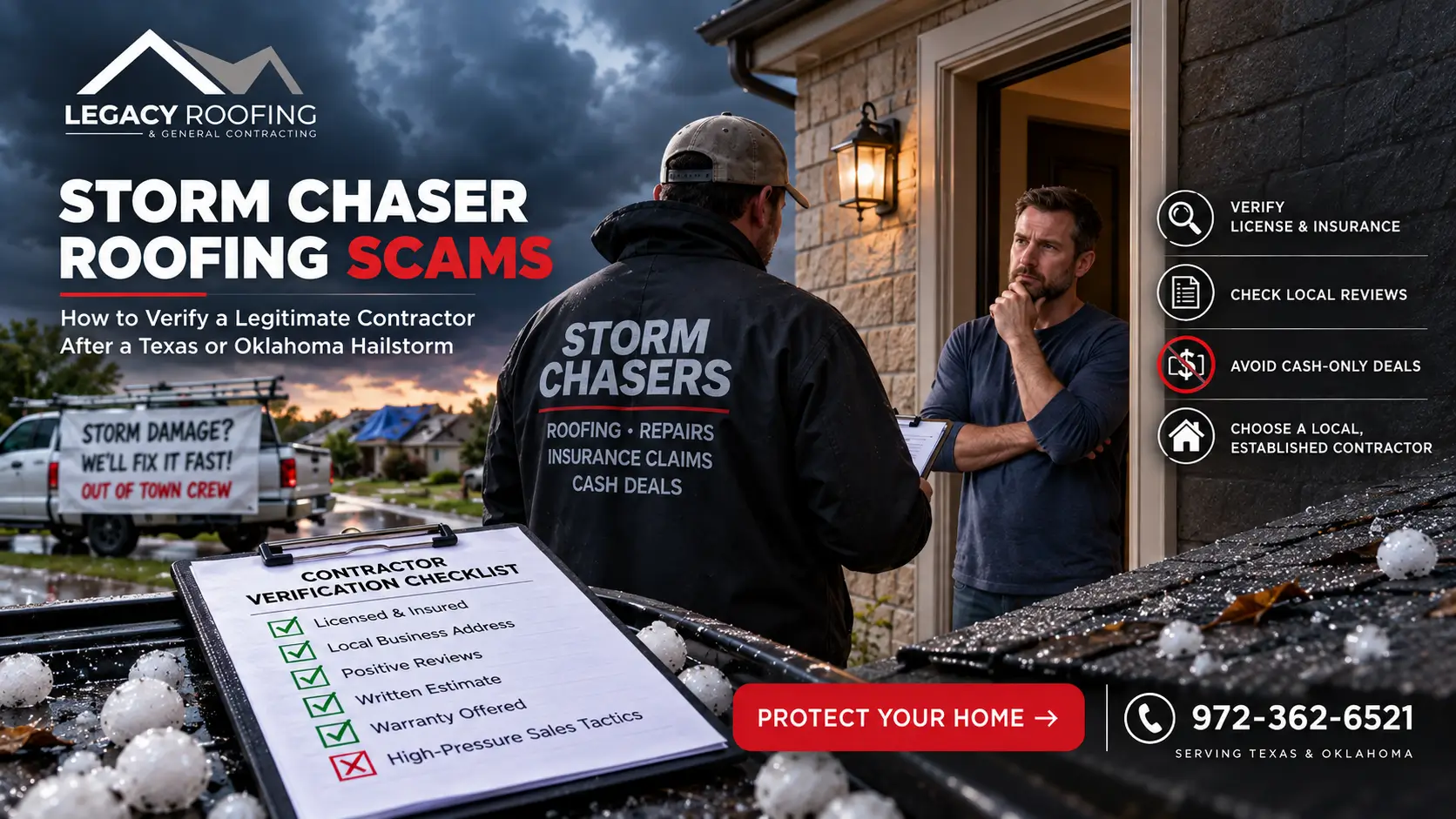
A major hailstorm can damage hundreds or even thousands of roofs within minutes. Soon afterward, homeowners may notice roofing trucks, door hangers, salespeople, phone calls, and offers for immediate roof inspections.
Many roofing contractors who respond after storms are legitimate businesses helping communities recover. Others may be temporary operators or scammers hoping to collect deposits, insurance proceeds, or signed contracts before disappearing.
Knowing how to spot a storm chaser roofing scam can help you protect your home, money, and insurance claim when you are already dealing with storm damage.
Texas and Oklahoma homeowners should never feel pressured to hire the first contractor who knocks on the door.
Legacy Roofing & General Contracting works with homeowners throughout both states and encourages property owners to verify any contractor carefully before signing a roofing agreement.
What Is a Storm Chaser Roofing Contractor?
The term "storm chaser" generally describes a roofing contractor or salesperson who travels into an area shortly after a major hailstorm, tornado, hurricane, or wind event.
Traveling for storm work is not automatically dishonest.
The concern begins when a company has little connection to the community, uses high-pressure sales tactics, provides unclear business information, or disappears when warranty problems appear later.
Texas officials specifically warn that out-of-town scam operators may arrive quickly after disasters. Oklahoma's Attorney General issued similar guidance in April 2026, warning homeowners that contractor fraud often increases after severe storms.
How to Spot a Storm Chaser Roofing Scam
There is rarely one single sign that proves a contractor is dishonest.
Instead, watch for several warning signs together.
1. They Pressure You to Sign Immediately
A contractor may say:
- The offer is only good today
- Material prices will double tomorrow
- Your neighbors already signed
- Your insurance company requires immediate action
- You must sign before they can inspect the roof
A professional contractor should give you time to read the agreement and understand what you are signing.
Texas regulators specifically warn homeowners to read anything presented as an inspection authorization because it could actually be a binding contract.
2. They Ask for Full Payment Upfront
Large advance-payment demands are a serious warning sign.
A contractor may need a reasonable deposit depending on the project, but asking for the entire roof price before materials arrive or work begins creates unnecessary risk.
Texas and Oklahoma consumer authorities both advise homeowners to be cautious when contractors demand large upfront payments.
3. They Offer to Pay Your Insurance Deductible
This is one of the clearest roofing scam red flags in Texas.
A salesperson might say:
"We'll cover your deductible."
"We'll give you a rebate equal to your deductible."
"We can build it into the insurance estimate."
Texas law prohibits contractors from waiving, rebating, absorbing, or otherwise helping a homeowner avoid paying a required property insurance deductible.
If a roofer's main sales pitch is that you will not have to pay your deductible, find another contractor.
4. The Contract Contains Blank Spaces
Never sign a roofing agreement with missing prices, unfinished scope details, blank material selections, or spaces that can be filled in later.
Your contract should clearly identify:
- Contractor
- Property
- Roofing materials
- Work being performed
- Price
- Payment schedule
- Warranty
- Expected responsibilities
A written contract protects both parties when the scope is clear.
5. They Want the Entire Insurance Payment
Be cautious when a contract simply says the homeowner agrees to pay "all insurance proceeds" rather than giving you a detailed project price and scope.
Texas insurance regulators specifically warn homeowners about vague agreements tying contractor payment to the entire insurance settlement.
How to Avoid Roofing Scams After a Hail Storm
The best time to protect yourself is before signing anything.
After severe weather, follow a simple verification process.
Get Multiple Written Estimates
Try to compare more than one roofing company when circumstances allow.
Written estimates make it easier to compare:
- Materials
- Repair scope
- Replacement scope
- Ventilation
- Flashing
- Underlayment
- Cleanup
- Warranty
- Pricing
An estimate that is dramatically lower than every other proposal deserves additional scrutiny.
Verify the Company's Address and Phone Number
Look beyond the salesperson's mobile number.
Ask:
- Where is your business located?
- How long have you served this area?
- Who handles warranty calls?
- Who will supervise my project?
- Can I reach the office after the storm season ends?
An established local presence does not guarantee perfect work, but it makes accountability easier than dealing with an unidentified temporary operation.
Ask for Proof of Insurance
Request a current certificate of insurance and verify the information when appropriate.
The company name on the certificate should match the contractor you are hiring.
Insurance is especially important because roofing involves working at height, heavy materials, ladders, equipment, and potential property damage.
Texas officials specifically recommend requesting and verifying contractor insurance information.
How to Verify a Roofing Contractor's License in Texas
Homeowners frequently search "verify roofing contractor license in Texas," but there is an important distinction to understand.
Texas does not currently operate a statewide roofing-contractor licensing program through the Texas Department of Licensing and Regulation. Roofing is not listed among TDLR's licensed and regulated programs.
That means a salesperson claiming to have an official "Texas state roofing license" deserves closer questioning.
What Should You Verify Instead in Texas?
Because there is no statewide roofing license, investigate other credentials.
Check:
- Local contractor registration requirements
- Required city permits
- General liability insurance
- Business name and address
- References
- Online customer feedback
- Manufacturer certifications when claimed
- Written workmanship warranties
- Length of time in business
Local requirements can vary by city, so ask the applicable building department whether registration or permits are required for your project.
Do Not Confuse Certification With a State License
A roofer may legitimately hold:
- Manufacturer certification
- Industry association credentials
- City contractor registration
- Specialized trade credentials
These can be useful qualifications, but they should not be presented as a Texas statewide roofing license.
Homeowners researching a contractor in North Texas can learn more about roofing services throughout Dallas-Fort Worth.
How to Verify a Roofing Contractor in Oklahoma
Oklahoma works differently.
Roofing contractors performing covered roofing services in Oklahoma are required to obtain a roofing contractor registration from the Oklahoma Construction Industries Board, commonly called the CIB.
The state requires active residential roofers to provide proof of at least $500,000 in business general liability insurance as part of the registration requirements. Commercial roofing contractors have additional endorsement and insurance requirements.
Ask for the Oklahoma Registration Number
Before hiring an Oklahoma roofer:
- Ask for the contractor's registration information.
- Confirm the business name matches.
- Check that the registration is current.
- Verify the contractor is properly qualified for the type of roofing work being proposed.
- Ask for insurance documentation.
Oklahoma homeowners can also report suspected unregistered roofing activity to the Construction Industries Board.
What About Oklahoma's New Residential Endorsement?
Oklahoma is introducing an additional Residential Roofing Endorsement.
However, homeowners should understand the timeline.
Current CIB guidance says the transition begins January 1, 2027, and the Residential Roofing Endorsement becomes required for residential roofing work beginning January 1, 2028.
In 2026, homeowners should still verify the contractor's current Oklahoma roofing registration rather than rejecting a contractor simply because the future residential endorsement has not yet become mandatory.
Legacy Roofing provides roofing assistance for property owners in Oklahoma City and Tulsa.
Licensed Roofing Contractor Red Flags to Watch For
Homeowners searching for licensed roofing contractor red flags should focus on whether the contractor's claims can actually be verified.
Be careful when a roofer:
- Refuses to provide insurance documentation
- Gives no physical business information
- Cannot provide references
- Avoids questions about permits
- Uses a different company name on the contract
- Requests cash only
- Demands full payment before work
- Pressures you to sign immediately
- Leaves major contract sections blank
- Promises to eliminate your deductible
- Claims they can guarantee insurance approval
- Cannot explain who will perform the actual work
The presence of one concern does not automatically prove fraud, but several together should cause you to slow down.
Be Careful With Insurance Claim Promises
Roofers can inspect roofing systems, identify visible damage, prepare repair estimates, and complete roofing work.
Insurance coverage decisions belong to the insurance company under the policy.
Texas law also prohibits a roofing contractor from acting as a public insurance adjuster on a property when that contractor is performing or may perform the repair work. Roofers should not present themselves as the homeowner's claim negotiator or promise to recover a particular insurance settlement.
If storm damage may involve insurance, review Legacy Roofing's guide on whether to call a roofer or insurance company first.
Verify the Roof Damage Too
A storm chaser scam does not always begin with money.
It can begin with exaggerated damage.
A salesperson may tell a homeowner that the entire roof is destroyed even when the homeowner has not received an independent assessment.
Before committing to replacement, ask the contractor to explain:
- Where damage is located
- What components are affected
- Whether repair is possible
- Why replacement is recommended
- What photographs support the recommendation
For additional information, review the guide to identifying hail damage on your roof.
A professional roof inspection should help you understand the condition of the property rather than pressure you into a decision.
What Should a Legitimate Roofing Estimate Include?
A trustworthy roofing proposal should be specific enough to compare with another bid.
Look for details such as:
Roofing Material
The agreement should identify the type of shingles, metal, membrane, or other material being installed.
Scope of Work
It should explain whether the project includes tear-off, decking work, underlayment, flashing, ventilation, ridge caps, disposal, and cleanup.
Price and Payment Terms
You should understand:
- Total contract price
- Deposit
- Progress payments
- Final payment
- Potential additional charges
Warranty Information
Know who provides each warranty.
There may be separate manufacturer and contractor workmanship warranties.
Business Information
The contract should clearly identify the roofing company and its contact information.
Legacy Roofing homeowners preparing for an insurance-related inspection can also use this roof inspection checklist for insurance claims.
Door-to-Door Roofing Is Not Automatically a Scam
A contractor knocking on your door after a storm does not automatically make that company dishonest.
Roofing companies often perform inspections in neighborhoods where hail or wind has recently occurred.
The difference is how the contractor behaves.
A professional representative should allow you to:
- Ask questions
- Research the business
- Review the agreement
- Verify insurance
- Compare estimates
- Decline the service
The Oklahoma Attorney General specifically lists unsolicited offers and high-pressure sales tactics among warning signs homeowners should evaluate after severe weather.
Why Local Reputation Matters After Hail
Roof replacement is not finished when the last shingle is installed.
You may need the contractor later for:
- Warranty questions
- Leak inspections
- Flashing issues
- Manufacturer documentation
- Maintenance
- Future storm inspections
That is why it can be useful to research how long a company has operated and whether previous customers can still reach it.
Homeowners researching Legacy Roofing & General Contracting can view the company's Google Business Profile and customer reviews as one part of their contractor research.
You should use the same verification process for any roofing company you consider.
What to Do If You Think Your Roof Has Hail Damage
If a Texas or Oklahoma hailstorm recently affected your property:
- Photograph visible exterior damage from a safe location.
- Do not climb onto a wet or damaged roof.
- Record the storm date.
- Check your insurance policy.
- Arrange a professional roofing inspection.
- Compare written estimates if substantial work is required.
- Verify the contractor before signing.
Legacy Roofing & General Contracting offers residential roofing services in Texas and Oklahoma for homeowners who need inspections, storm damage repairs, or roof replacement.
Frequently Asked Questions About Storm Chaser Roofing Scams
How can I tell if a storm chaser roofer is legitimate?
Verify the company's address, insurance, references, written estimate, business history, and applicable registration requirements. Avoid contractors who pressure you, demand full payment upfront, leave contract sections blank, or promise unrealistic insurance results.
How do I verify a roofing contractor's license in Texas?
Texas does not currently have a statewide roofing license through TDLR. Instead, verify applicable city registration and permit requirements, insurance, references, manufacturer credentials, business information, and contractor history.
How do I verify a roofer in Oklahoma?
Check whether the contractor maintains the required registration with the Oklahoma Construction Industries Board. For applicable commercial projects, verify the required commercial endorsement as well.
Is it illegal for a Texas roofer to waive my deductible?
Yes. Texas prohibits contractors from waiving, rebating, absorbing, or helping homeowners avoid paying the required property insurance deductible.
Should I pay a roofing contractor the full amount upfront?
Be cautious. Texas and Oklahoma consumer agencies warn homeowners about contractors seeking large upfront payments, particularly after major storms. A written contract should clearly explain the payment schedule.
Is every door-to-door roofer a storm chaser scam?
No. Legitimate roofing companies may offer inspections in storm-damaged neighborhoods. Focus on the contractor's credentials, business history, documentation, insurance, sales behavior, and willingness to let you research the company.
What should I do if a roofer says my entire roof needs replacement?
Ask for photographs and a clear explanation of the damage. Consider getting another inspection or estimate before signing a replacement contract, particularly when you do not see obvious damage yourself.
Can a roofer negotiate my Texas insurance claim?
A Texas contractor who is performing or may perform the repair work cannot also act as the public insurance adjuster for that property. The roofer can document roofing conditions and prepare repair information, while insurance coverage decisions remain separate.
Protect Your Home Before You Sign
Learning how to spot a storm chaser roofing scam is especially important when hail has damaged an entire neighborhood and homeowners feel pressure to act quickly.
Urgency should not replace verification.
Check the company. Confirm the applicable credentials. Verify insurance. Read the contract. Compare estimates. Never accept an illegal deductible-waiver offer. Make sure you know who will stand behind the work after storm season ends.
Legacy Roofing & General Contracting works with homeowners throughout Texas and Oklahoma who need professional roof inspections, repairs, and replacements after severe weather.
Contact Legacy Roofing & General Contracting to schedule a roof inspection and get clear information about your roof before making a repair or replacement decision.


